
Auspect
A powerful acoustic analysis software can calculate various underwater noise index values in real time.
RC Module
Connected to the underwater noise meter Seagnals, it has three operating functions: stream mode, index mode and logger mode for buoy, in-line and self recorder. Underwater noise waveform, spectrum, time-frequency spectrum and data files can be viewed in real time.
Feature
-
Calculated according to ISO 18405 and ISO 18406 standards.
-
Applicable domestic regulations NIEA P210.22B.
-
Complies with IEC 61260-1 1/3 octave filter requirements.
-
Can be calibrated according to IEC 60565-1 and IEC 60565-2.
-
Automatically create raw data files and digital report files.
Audio Capture
Auspect RM Module supports various audio capture cards or analog-to-digital converter (ADC) devices with sampling rates above 96 kHz and data depths of 16 or 24 bits. The storage file format is lossless PCM-WAV, and the files are automatically cut into designated seconds for archiving.

Measurement Setting
In the measurement settings, enter the identification file and hydrophone serial number to meet data quality control and traceability requirements. By setting the hydrophone sensitivity and signal amplifier gain, the captured radio wave data can be converted into underwater noise sound pressure data.

Monitoring Criteria
User can set the detected level of underwater noise peak (Lp), AUSPECT will automatically detect the pulse wave signal, and count the number of single stroke (SS) every 30 seconds.


Alert Function
User can set the alert level of the underwater noise equivalent sound pressure level (Leq). The alert threshold will be displayed according to the limit rate (Lss.p).

Reporting Data
Auspect RM Module automatically generates underwater noise analysis results and provides electronic data reports at any time.

Feature
-
Calculated according to ISO 18405 and ISO 18406 standards.
-
Applicable domestic regulations NIEA P210.22B.
-
Applicable to international ship classification DNV Silent URN.
-
Calculates weighted hearing thresholds for marine mammals.
-
Can be used to assess the impact of underwater noise on marine animals.
Load File
Auspect AS Module supports WAV or CSV file formats and loads. The file sampling rate, data depth, signal voltage range and ratio can be automatically identified by reading WAV heading or manually input. Setting the start time of file recording can compare the actual time when the underwater noise occurs. Audio files can be played.

Waveform Check
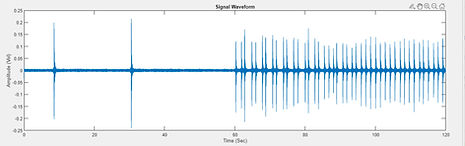
The original data can be checked in the waveform display to see if there are any anomalies, such as sound pressure exceeding the capture range and causing clipping.
Calculation Parameters
The Sound Pressure Calculation requires setting the underwater microphone sensitivity and amplifier gain value during measurement.
The Time Stamp of Spectral Calculation needs to set the fast Fourier transform (FFT) parameters and time weighting.
Post-processing in spectrum for Receptors can select octave band filters, animal hearing weighting, calculation parameters for animal exposure to underwater noise value, underwater noise limit threshold, sound propagation loss calculation, distance between animals and underwater noise sources, and cumulative exposure time, etc.

Pile-driving Analysus Reports
By setting the underwater noise data segment to be analyzed in the sound wave time series, a spectrum can be generated. The reports indicate the estimation of underwater noise source level, SEL for animal receptor weighting hearing, the noise level of animals hearing at a specific distance, the cumulative impact of exposure time, and the display of underwater noise limit thresholds.

Ship Underwater Radiated Noise (URN) Analysis
According to the international ship classification underwater radiated noise standards (notations), the ship noise data is analyzed and whether it meets the limited threshold is displayed on the spectrum.

Spectrogram
The spectrogram can be viewed to analyze the relationship between underwater noise changes in time series and frequency range.
